My wife and I have been separated for some years. She lives in a flat in town and I’m out here in the burbs with the lawn mowers and the drug dealers. But we still see each other—daily. I’ll drop over for lunch (she’s made a Moroccan casserole and there’s too much for one person) or she’ll stop in on her way back from somewhere to pick up a bag of lemons from our tree.

We also have our projects. Last week she turned up with a broken wall clock; Saturday there was a problem with her car’s petrol cap; and recently we’ve been working on finding her a new phone.

We were both in management before we retired, so we like problem-solving. First, she wrote out the criteria for her new phone (both essential and nice-to-have), did the research, studied the reviews and visited phone user forums. Once she’d settled on a model, I went to that auction site and found several quality candidates that balanced price, battery-life and condition (‘imperceptible scratching on the frame’ versus ‘a tiny abrasion on the logo’). Once delivered, I sent her a photo of the box on the kitchen table and a thumbs up emoji. She replied with a green heart.

Next, we worked on how to set up the new phone, how to migrate years of messages and photos, what apps to keep, what plugs and cables were required. I sent her a link to a YouTube video where a technician rehearsed the sequence of manoeuvres needed to effect the upload. ‘It’s easy,’ he said showing us how the phone should look when the transfer was done. 'You see, happy phone.'

Before the phone project, I had a washing machine emergency. She quickly researched noise ratings, water efficiency and which companies had the lowest carbon footprint and highest ratings for ethical manufacturing. I did the install.

‘What a team,’ she said as we stood together in the laundry that afternoon watching the new washer slosh through its first cycle. Then we did a clumsy hi-five and for a moment her hand came to rest warm in mine.

As I sit at my bench with the wall clock disassembled about me, I wonder will this end? Will there come a time when all our appliances are working, all our lightbulbs, our automobiles? Then I look at the flimsy plastic screws they’ve used to fix the clock in place and realise that cheap industrial design will keep us in projects for years.

I was walking the dog on the beach yesterday morning. A pale wintrous sun had barely crested the horizon and a brisk easterly eddied the sand. A couple had stripped down and were walking into the water (even though the sea is currently down to 18 degrees and with the wind it must have been much colder). They stood apart. Neither egged the other on—it was clear they were serious about the swim. I saw how they hunched into themselves as they entered the water: knee- then waist-deep and I could hear them gasp as a wave broke over their shoulders. Ahead of them waves were lined up across the bay, coming on one after the other.
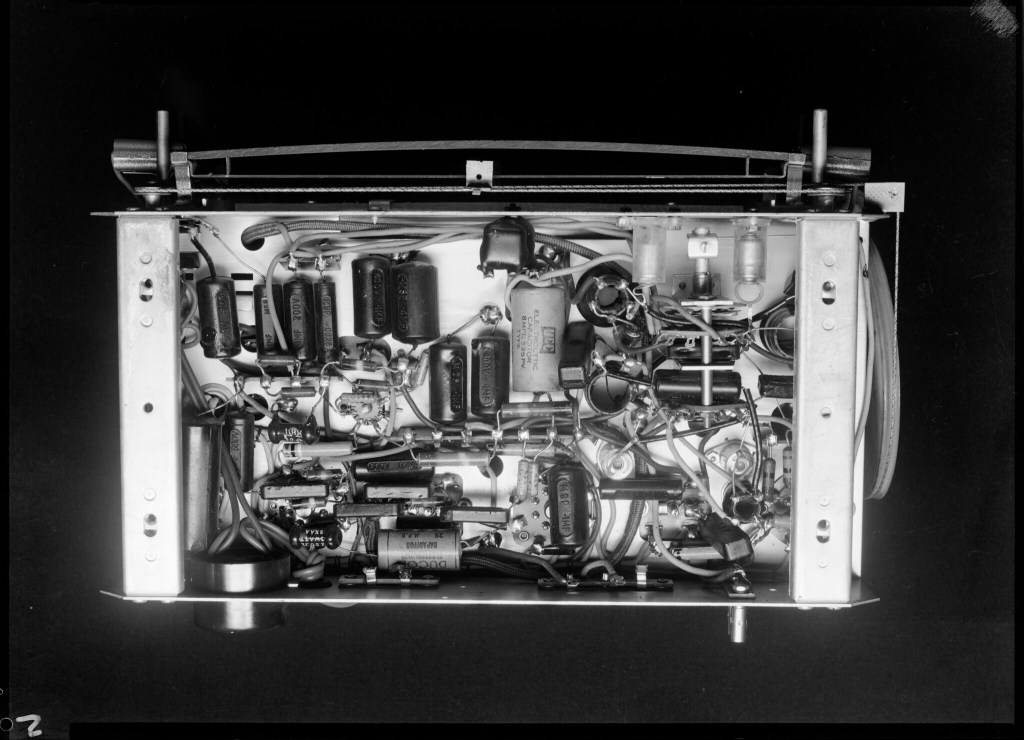
Image: Circuits and electronic components of an AWA radio, Sydney, Australia, 1948 – 1953, by Max Dupain c/- State Library of NSW on Flickr.
And for music this morning from 2009 here’s Swedish jazz trio the Esbjörn Svensson Trio (or e.s.t) with From Gargarin’s Point of View (and Youtube) – from Retrospective The Very Best of E.S.T. (Youtube)

 Peter Frankis writes