such a battle
just reading your poetry
mosquitoes dance      the page
she will inherit (not us)
— how she sings the harvest
Image: untitled by Daniel Iván on Flickr. A piece inspired by Rodney Jones’ poem about war and violence The Mosquito – which I was reading in my kitchen at 5am under attack from the subject of his poem (the last line is taken from his poem).
And for music today here’s some uplifting “nature punk” from US band/singer Hurray for the Riff-Raff – with Life on Earth (Youtube) (The whole album is gorgeous and recommended).
impatient the air
slams a door, a saucer
certainty of downpours
evaporates before
reaching this far
Image: Utagawa Hiroshige, Sudden Shower over Shin-Ōhashi Bridge and Atake, from the series One Hundred Famous Views of Edo 1857. c/- Metropolitan Museum
And for music this morning, here’s Japanese composer Isao Tomita with Claire de Lune (Youtube). The whole album (sorry couldn’t find it on Youtube but there’s plenty of Tomita for you to enjoy) is pretty fab from the master of synths. (I remember my father bringing home one of Tomita’s LPs and we sat fascinated that all this music was without a single instrument being bowed or blown into or orchestra being conducted)
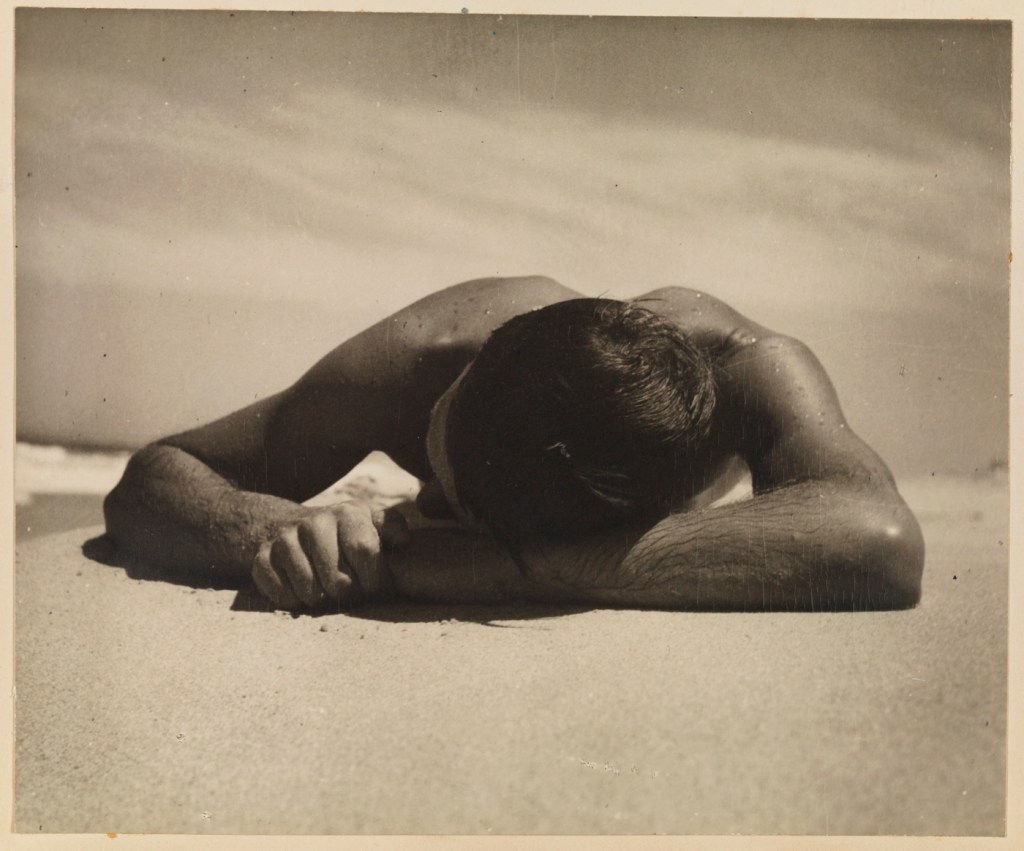
barely waves, turquoise
lift and settle
of surfers
collective supplication
anything, send us anything
Image: Harold Salvage sunbaking, “The Sunbather” from Camping trips on Culburra Beach by Max Dupain and Olive Cotton c/- State Library of NSW on Flickr
Music this morning, here’s Australian musician Andrew Tuttle with reminiscence of Alexandra (Youtube has the live performance), very chill – banjo, cicadas and sprinklers on the lawns – and no surf today.
Music this morning, something uplifting featuring my favourite mezzo Cecillia Bartoli. Here’s Agostino Steffani (no relation to Gwen) with Stabat Mater (Youtube)
bluebag of a day
one quick dunking
final rinse the sky
then hung brighter
flower the very bee
Image by Vidar Nordli-Mathisen on Unsplash. Today was one of those cloudless perfect days that a friend described as a ‘bluebag’. This referenced Reckitt & Coleman’s laundry product, a history of laundry and the (incomplete and wildly speculative) wikipedia entry for bluing (fabric): bee sting remedies, hoodoo spells and blue hands.
Unrelated, for music this morning here’s Cecilia Bartoli with cellist Sol Gabetta with some sweet duets (youtube)
blown sand blocks our street
duneland has returned
like the past
finds us oddly
unready its tidings
Image: Dunes south of Port Kembla, c. 1940s c/- Wollongong Library. A tanka inspired by the brief closure of a local road after a few days of strong southerlies. This area was subject to some ‘dune shaping’ recently by the local council which involved removal of foredune vegetation which (in my view) helped stabilise the sand. That said, the past is implacable.
Music this morning, here’s British vocal ensemble Voces8 with a reworking of Radiohead’s Pyramid Song (Youtube).
Wollongong poet, publisher and Australian poetry legend Ron Pretty has published a collection of his work over 50 years of writing.
Poetry shifts so quickly it can be hard to keep up. Sometimes I imagine it as a wave, its front rising up full of new exciting voices; voices that have been ignored or silenced; sassy angry voices talking back to the blandness of popular culture and late stage capitalism; urgent voices insisting we act on environmental destruction now.
“Jackson’s book is an extraordinary poetic exploration of his own disability – Marfan’s syndrome, which is disfiguring and distorts the shape of his face and body. His poems are blistering in their power, wonderfully subtle, objective and with no self-pity. “
Similarly, this year I listened to readings from a new anthology Admissions from Red Room Poetry, poems written from the lived experience of mental illness. My warmest memory of that night is as one of the poets came to the critical point in the poem he was struck dumb, overcome with emotion. And we, a room of 80 fans and friends, held our breath as the poet found his composure and courage to keep reading. Powerful words indeed.
So what to make of a collection of someone who’s been writing poetry for over 50 years, has published eight full collections and six chapbooks of poetry? To continue the surf metaphor, this poetry is from the green water out beyond the breakers, it’s deep and cool and collected and exhilarating in its own way. Yes, there are experiments in form, in voice and subject but it also points to the evolution of a writer over time.
Recently, I voiced Ron’s words for a program on Radio 3CR in which two of his poetry colleagues — Kevin Brophy and Alex Skovron — read from 101 poems. It’s a terrific program put together by Tina Ginannoukos from the Spoken Word team at 3CR and gives you an introduction to Ron Pretty’s work (a longer extended version is also available).
After listening to this, you’re going to want to immediately order a copy from Ron’s publisher Pitt Street Poetry.
3CR spoken-word program: The work of Ron Pretty, December 22, 2022.
And for music this afternoon (where it’s raining on newly mown summer grass) here’s American composer Caroline Shaw with the Attacca quartet playing Orange (Youtube)
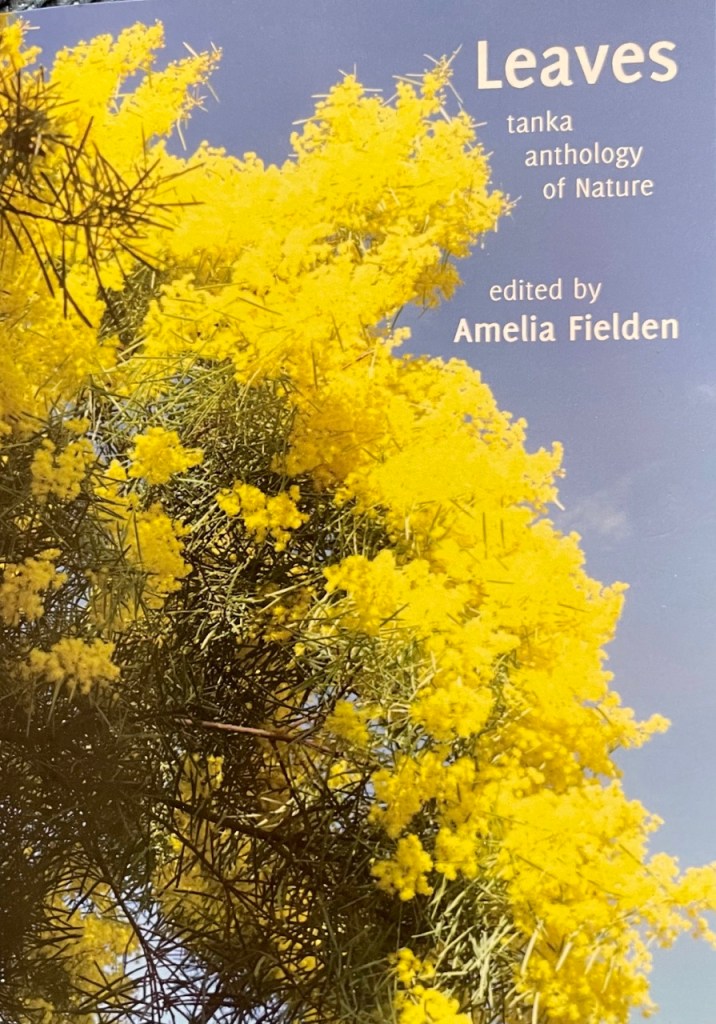
This beautiful little volume edited by Amelia Fielden and assisted by Liz Lanagan collects the work of 35 poets. Wrapped in a glorious colour photo of winter blooming wattle by poet photographer Neva Kastellic, this B5 volume sits comfortably in your hand, in your pocket or on your bookshelf. Each poet presents two tanka (except for Fielden who, as editor, has three) so that’s 10 lines per poet. But there’s never a sense of poets clamouring or competing for attention. Instead, Leaves presents a diversity of voices and a kaleidoscope of views.
The poets are mostly Australian, along with Japanese-Australian poet Saeko Ogi and a guest poet from California, Neal Whitman.
In the preface, Fielden tells us that the expression meaning ‘leaves’ in Japanese kotonoha is a homonym for ‘words’ which also alludes (in the way that everything connects to everything else) to the tanka form itself. A form, she continues, that can be traced back to 10th Century poet, Ki no Tsurayuki who begins his seminal work thus:
‘Japanese poetry has the human heart as seed and myriads of words as leaves.’
Generally, the poems are not of pristine idealised nature but rather nature in urban settings, nature exposing our foibles or nature butting up against us such as, for example, a currawong competing with poet/grower for an olive crop or a caterpillar rescued from being blended into pesto. Nature also provokes, as in this witty piece by Jenny Stewart
cut a little
says a wispy native shrub,
but not too much ...
make a decision
you with the rusty shears
There are references to popular culture: my own piece on Elvis (which I’m delighted to have included in this volume) and Kate King’s tanka referencing May Gibbs’ children’s tales of the gumnut babes Snugglepot and Cuddlepie and the scary gang that stalk them
knobbly seed pods
pounce from spiky bushes —
we still recoil
from those gumnut tales
of Big Banksia Men
There’s also the achingly contemporary, in Rachel Colombo’s tanka
lonely cherry tree
in the wintry Kyiv street
a bomb explodes
days later buds burst
showering pink blossom.
And of course, poets talk about the craft of poetry, as in Amelia Fielden’s tanka
in full thrum
cicadas emphasising
the summer days —
less is more, I tell
my tanka students
At the launch of Leaves, one of the poets quipped that tanka was ideal for our times: small, memorable, a poem you can hold in your hand, perfect for the short-attention-span days of twitter and instagram. Yet these poems have depths that you will want to return to as each ‘leaf’ offers a different insight to nature and the human condition in these challenging times.
Leaves, tanka anthology of Nature is available from Australia’s finest small press, Ginninderra Press
The woman waddles over the warm cement to the end of the pool. She’s put on a little weight over winter and she’s puffing a bit. She closes in on the deep end, fits her goggles and looks down into the familiar green, the Ionian Sea. Then up on the balls of her feet, head down arms together. The whistle releases her. Push forward and belly slap into the cold—

The water holds her up.

Some of their spines are bent with scoliosis, some grind in their hips or knees. One is lost and her sisters take her by the hand, bring her to her place in the relay. This is their time, a couple of hours on Thursday morning. They love each other, these women, these ariels and ursulas, dorys and madisons. They love each other but once in the water they compete.

The water is a return.

As a teenager she’d lean through the pool with perfect efficiency, head turn for a kiss of air, bow-wave rising from the bridge of her nose. All effortless speed, she was born to this. Dolphin Girl her Dad called her. Bronze in the State and would’ve gone to the Nationals but they couldn’t afford the fares. And then there was Frank and that was that.

The water tells the truth.

Today her arm won’t extend, her hip’s stuck and the kick only works in one leg, the other just drags. And she’s gasping for breath. She moves in awkward esses down her lane. Halfway and there’s the wash as her rival passes.

The sky is empty. A flight of gulls dip low over the pool then rise, buffeted by the easterly. Supposedly they carry the souls of sailors now doomed to chase bin scraps.

Men. A few watch from the concrete benches, old blokes sunning themselves, leather bellies over tiny speedos—they yawn and scratch like a lounge of seals.

The water holds her up.

She’ll be damned if she stops. Slowly, the body remembers, rhythm returns to her breathing, arm comes higher. The lane marker straightens and the water holds her up

—and at the end the mermaids are cheering.
A short piece dedicated with affection to the Port Kembla Mermaids. And for music this morning, what else but Song to the Siren? A 1984 cover of the Tim Buckley song featuring the guitar of Robin Guthrie and voice of Elizabeth Fraser (Cocteau Twins) – and lots of hair gel.
This piece was written on the lands (and the Port Kembla Mermaids swim in the waters) of the Wadi-Wadi people, traditional owners and custodians of the Illawarra.





 Peter Frankis writes