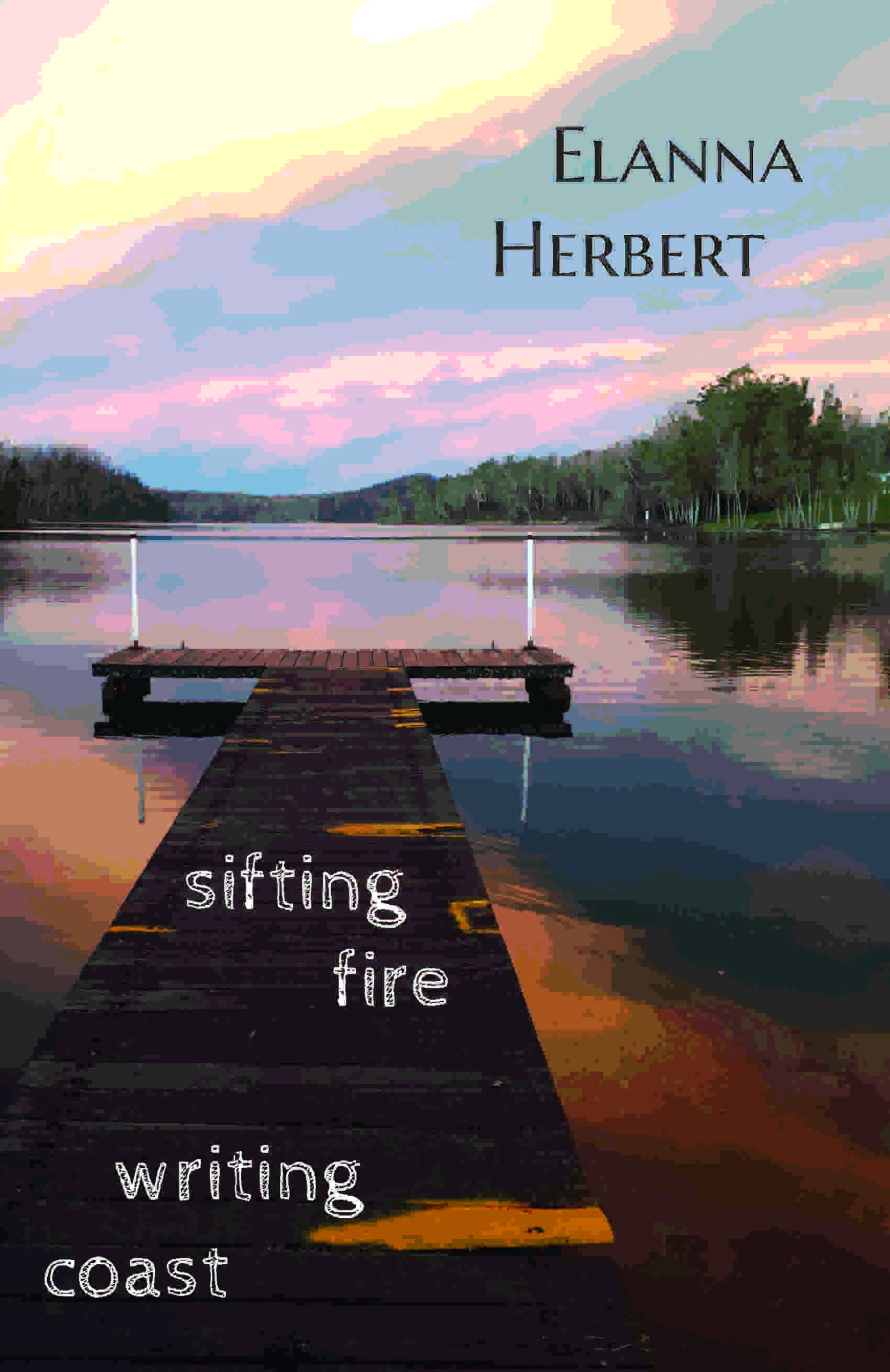
Review – Sifting Fire Writing Coast, Elanna Herbert, Walleah Press, 2023

A commentator in The Saturday Paper recently wrote piece seeking to explain the exhaustion many of us feel. Why we turn away from the news in favour of binge-watching crime dramas or english royalty on Netflix. The term she used was ‘polycrisis’ where multiple things go wrong at the same time: fires, accidents, COVID resurgent, wars starting (again) globally. 

While reading Elanna Herbert’s new book of poetry, Sifting Fire Writing Coast from Tasmanian publisher Walleah Press, I thought about polycrisis.

Herbert’s poetry has been widely published and awarded, although this is her first collection. While these poems were written over several years there’s a clear thematic focus to the collection.  The book is divided into three sections: Fire which deals largely with the trauma of the 2019/20 bushfires in South East Australia (the poet’s house barely survived but many neighbouring properties were lost and a local resident died); Sifting which turns to more personal poems as well as poems with international settings Turkey, Egypt, Italy and Kokoda in Papua New Guinea; and Coast which explores issues around travel and transit.  Even before you get to the first poem, the preamble sums up the tone of what follows:

‘fire:
with your bright new meaning
you bastard...’  

In Fire Rites, we are reminded of Scomo (former Australian Prime Minister Scott Morrison) eager for Hawaii as locals face the fiery apocalypse. ‘Watch from my night-deck on the ridge line/your orange-red glow of still burning trunks reignites us./:incendiary.  

Again and again, the poet returns to the fires: a revealing list of what to take when the fire arrives (cross out any which no longer apply); walking out after the fires into a ruined landscape in Part of its trunk (which won the June Shenfield National Poetry Award 2020); or finally When the first rain comes ‘It is pathetic.’ 

Processing Afghan Asylum Seekers adds a somewhat lighter touch to the grimness of Australia’s ‘turn back the boats’ policy. Herbert worked as an immigration officer for a period so writes authoritatively. She describes the checked flannel shirt as an act of fashion defiance against the Taliban and then (metaphorically) leans over and confides:  ‘you can spot the ones who’ve spent years in detention they still walk slowly energy saving…’  As the first section closes the poet finds a kind of redemption. Firepit (which was shortlisted for the 2021 ACU Poetry Prize) tells of an item recovered from the ruins of a neighbour’s house re-purposed as waterhole for two surviving Bower Birds.  

‘Today two Bower Birds discovered my stolen
iron firepit, holding the dichotomy firmly 
by the rim, simultaneously fire and water. The
male glorious as ever in satin, midnight blue.
Iridescent. The female camouflaged, a piece of 

Soft green speckle, jittery, drinking at her new
waterhole.  

Sifting opens with a poem in memory of her father The Yass Fossils 

...being with Dad 


in the year i discover Science, things new


exciting, close. i became important, almost


a real thing, when he took me and the boy


next door to visit Science.  

Notice the small i personal pronoun, so tentative on the page where Science (and Dad) gets a capital. 

Coast the final section of the book, has some gentler descriptive pieces such as Leaving Flores and Lake Conjola 

read the reflection 


in the January king tide


like stars float on a surface


of black infinity water


big diamond little diamond


phosphorescence 

It also contains poems that deal with being rootless, bouncing between one coast and another. A favourite is the poem ‘east…west….east……west……east……west… where each blocky stanza deals with one location and time separated by the shifting refrain ‘so far home, flying across a continent’. Between the beauty of the Milky Way on a clear night in Gundaroo (outside Canberra), to Sydney and Conjola ‘fruit bats & lakes night surf’, to the thirsty soil of Perth ‘wedged between a neighbour who has a boat and hates trees & a neighbour without a boat who speaks truth…’ there’s always flight. By the end of the poem, flight feels brutal and wrenching. Here is the poet as nomad always flying somewhere, rootless; any connections are interim and provisional.  

The collection closes with another tough poem, SIEV221 File Note: to mothers waiting. Here’s the poet on Christmas Island on 2010 finding flotsam from the wreckage of an Indonesian fishing boat, in which 50 people died and became the worst civilian maritime disaster in Australia in more than a century. 

Herbert currently lives on the south coast of NSW, although she has lived, worked and travelled in Canberra, Perth, South Australia and many other dry locations, and this dryness suffuses much of this poetry. It feels like the poet is working there, working amongst the ashes and the dust and raking over the hard-baked soil, writing about crisis, and fires and asylum seekers and ruined lakes. Using a variety of forms: list poems, prose, a stanza-ed poem, non-standard typography, she deftly explores and sifts through the particulars of place and being and our shaky connections to the land as settlers on this arid country.  

To be clear, I like this collection, it is engaging, purposeful and gutsy poetry. More importantly though, it shows what good poetry can do. In a time of polycrisis, poetry like this shows us how to talk about place and history and trauma; it toughens us up and gets us ready for what’s coming next.  

I hope we don’t have to wait years for Elanna’s next book (poetry publishers take note.) 


For music this morning, I’ve been listening to US gamelan player Daniel Schmidt’s 2016 album In My Arms, Many Flowers (Youtubers)

Vale Ron Pretty AM


On 30 June, friend, poet, publisher and tireless advocate for poetry Ron Pretty AM passed away at home after a long illness.

Ron had battled with deteriorating health for many years and in the last month he had contracted pneumonia which he was unable to shake. Ron is survived by his partner Jane, their two daughters Alana and Saroja and six grandchildren. 

A few highlights of his distinguished career of over 50 years:

  • helped establish the South Coast Writers’ Centre (this year celebrating its 25th year). 
  • From 1987 to 2007, he was the founding director of Five Islands Press, a leading publisher of contemporary Australian poetry. During his tenure, the Press published 230 books (that’s about one a month) by Australian poets, many of which have subsequently been shortlisted for or won prizes. 
  • Between 2000 and 2007, Ron ran the Poetry Australia Foundation – a foundation directed at promoting Australian poets and poetry. He is now a life member of its successor, the Australian Poetry Inc.
  • Ron Pretty’s services to literature, and Australian poetry in particular, were acknowledged by the NSW Premier’s Special Prize in 2001 and an Order of Australia (AM) in 2002. 
  • In 2012, the Australia Council for the Arts also awarded Ron a residency at the Whiting Studio in Rome. 

Last year (28 August, 2022) I joined with Ron at the launch of his last collection of poetry (his eighth book of poetry) 101 Poems published by Pitt Street Poetry. The text of our speech is here.

101 Poems is available through Pitt Street Poetry, along with his wonderful Creating Poetry – now in its 3rd edition. A celebration of Ron’s poetry is at Radio 3CRSpoken Word program and is now available as a podcast.

And here’s one of many favourite poems:

Wind

Such an evening: trees immobile, the sky
reaching citrus to the indigo escarpment,
finches playing at the bird bath, the world
holding its breath: nothing as perfect as this
can long endure. The lake is a sheet of steel,
there's a distant call of football at its play.

Night is also calling. Candles will be lit,
voices will hush a moment before resuming
their living squall. Out of southern darkness
comes the wind. Trees shiver, the candle
is soon snuffed out. Only in earth perfection
endures, for as long as cicadas and bones.

Will you light a candle for me, my love
in a corner where the wind never blows.

And for music, here’s one of Ron’s favourite composers Phillip Glass played here by Icelandic piano super-star Vikingur Olafson – Opening from Glassworks (Youtube)

Ron Pretty — 101 poems

Wollongong poet, publisher and Australian poetry legend Ron Pretty has published a collection of his work over 50 years of writing.

Poetry shifts so quickly it can be hard to keep up. Sometimes I imagine it as a wave, its front rising up full of new exciting voices; voices that have been ignored or silenced; sassy angry voices talking back to the blandness of popular culture and late stage capitalism; urgent voices insisting we act on environmental destruction now.  

Consider this year’s winner of the Australian Prime Minister’s Literary Award for Poetry, Andy Jackson’s Human Looking. To quote the judges:

“Jackson’s book is an extraordinary poetic exploration of his own disability – Marfan’s syndrome, which is disfiguring and distorts the shape of his face and body. His poems are blistering in their power, wonderfully subtle, objective and with no self-pity. “

Similarly, this year I listened to readings from a new anthology Admissions from Red Room Poetry, poems written from the lived experience of mental illness. My warmest memory of that night is as one of the poets came to the critical point in the poem he was struck dumb, overcome with emotion. And we, a room of 80 fans and friends, held our breath as the poet found his composure and courage to keep reading. Powerful words indeed.

So what to make of a collection of someone who’s been writing poetry for over 50 years, has published eight full collections and six chapbooks of poetry? To continue the surf metaphor, this poetry is from the green water out beyond the breakers, it’s deep and cool and collected and exhilarating in its own way. Yes, there are experiments in form, in voice and subject but it also points to the evolution of a writer over time. 

Recently, I voiced Ron’s words for a program on Radio 3CR in which two of his poetry colleagues — Kevin Brophy and Alex Skovron — read from 101 poems. It’s a terrific program put together by Tina Ginannoukos from the Spoken Word team at 3CR and gives you an introduction to Ron Pretty’s work (a longer extended version is also available). 

After listening to this, you’re going to want to immediately order a copy from Ron’s publisher Pitt Street Poetry. 

3CR spoken-word program: The work of Ron Pretty, December 22, 2022.

And for music this afternoon (where it’s raining on newly mown summer grass) here’s American composer Caroline Shaw with the Attacca quartet playing Orange (Youtube)

Hooray for the small

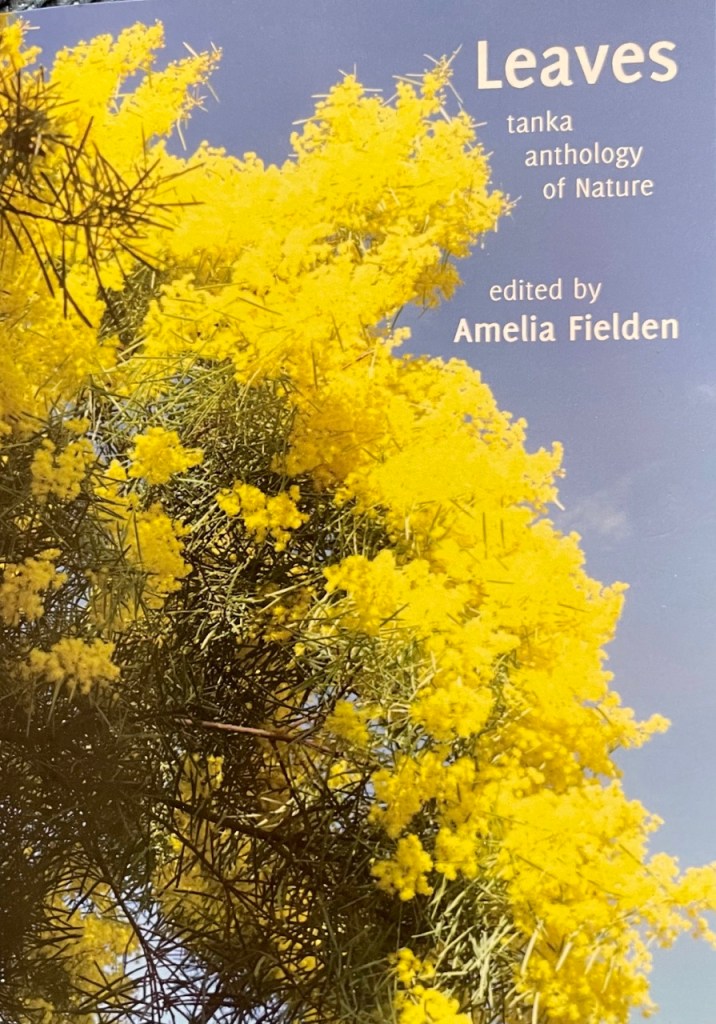
Leaves: tanka anthology of Nature, edited Amelia Fielden, Ginninderra Press, 2022, 43pp. 

This beautiful little volume edited by Amelia Fielden and assisted by Liz Lanagan collects the work of 35 poets. Wrapped in a glorious colour photo of winter blooming wattle by poet photographer Neva Kastellic, this B5 volume sits comfortably in your hand, in your pocket or on your bookshelf. Each poet presents two tanka (except for Fielden who, as editor, has three) so that’s 10 lines per poet. But there’s never a sense of poets clamouring or competing for attention. Instead, Leaves presents a diversity of voices and a kaleidoscope of views.

The poets are mostly Australian, along with Japanese-Australian poet Saeko Ogi and a guest poet from California, Neal Whitman.

In the preface, Fielden tells us that the expression meaning ‘leaves’ in Japanese kotonoha is a homonym for ‘words’ which also alludes (in the way that everything connects to everything else) to the tanka form itself. A form, she continues, that can be traced back to 10th Century poet, Ki no Tsurayuki who begins his seminal work thus:

‘Japanese poetry has the human heart as seed
and myriads of words as leaves.’ 

Generally, the poems are not of pristine idealised nature but rather nature in urban settings, nature exposing our foibles or nature butting up against us such as, for example, a currawong competing with poet/grower for an olive crop or a caterpillar rescued from being blended into pesto. Nature also provokes, as in this witty piece by Jenny Stewart

cut a little
says a wispy native shrub,
but not too much ...
make a decision
you with the rusty shears

There are references to popular culture: my own piece on Elvis  (which I’m delighted to have included in this volume) and Kate King’s tanka referencing May Gibbs’ children’s tales of the gumnut babes Snugglepot and Cuddlepie and the scary gang that stalk them 

knobbly seed pods
pounce from spiky bushes —
we still recoil
from those gumnut tales
of Big Banksia Men 

There’s also the achingly contemporary, in Rachel Colombo’s tanka

lonely cherry tree
in the wintry Kyiv street
a bomb explodes
days later buds burst
showering pink blossom.

And of course, poets talk about the craft of poetry, as in Amelia Fielden’s tanka

in full thrum
cicadas emphasising
the summer days —
less is more, I tell
my tanka students

At the launch of Leaves, one of the poets quipped that tanka was ideal for our times: small, memorable, a poem you can hold in your hand, perfect for the short-attention-span days of twitter and instagram. Yet these poems have depths that you will want to return to as each ‘leaf’ offers a different insight to nature and the human condition in these challenging times.

Leaves, tanka anthology of Nature is available from Australia’s finest small press, Ginninderra Press

Chasing the Line – An Anthology of Poems from the Back Room

Chasing the Line: An Anthology of Poems from The Back Room; Well Thumbed Poets 2022, 139pp. $25 (+ p & h) from Well Thumbed Poets

The back room of the title refers to a room in a bookseller – Well Thumbed Books in Cobargo NSW, a small town four hours south of Sydney on the Princes Highway between Narooma and Bega. 

The introduction to this volume describes a long wooden table where a group of seven local poets —  Linda Albertson, Leigh Crowe, Kai Jensen, Kate Taylor, Sandra Taylor, Glenda-mai Morgan and Peter Storey — have worked over the past few years to produce this rich volume. The latter two also provided the gorgeous colour illustrations for cover and the chapter dividers. 

Continue reading