the egret

It’s been a month since the contractors poisoned the weed that
was choking our suburban lagoon. Still water, mats of black collapse

the shore is quiet. Usually by October the reed warblers would be 
full-throated at their young: this our morning song, this an alarm trill 

this is how to hang a nest on two bent rushes just right. Next year 
— maybe. The pelicans mooch about before departing.

An egret wades in the shallows, brilliant 
like a tear in a curtain on a summer day. 

Yellow eye, yellow blade strikes, catches nothing. 
I want to make this bird into something — 

in its leanness and pallor, a township starved then razed
or our kids trampling helter skelter through the garden.

Unmoved, the bird stabs again, brings up a string of muck. 
It won’t mate this season; it’ll starve if it stays.

I’m thinking how hard it is to say anything cleanly, truly. 
Then the real bird lifts, a slow loping climb 

over lawns and picnic tables with a loud croaking call 
that I couldn’t help but hear as disgust.  

Image: An eastern great egret (ardea modesta) c/- David Clode at Unsplash, similar to the one so disappointed at our local lagoon.

And for music today, here’s Grown Ocean… “a large ensemble project by Sydney-based musician Novak Manojlovic”. with Memory Gardens (Youtube), which features songs inspired by the Illawarra NSW – where this poem was written. Maybe start with Rail Line, What Runs thru Coast & Colliery tho it’s all good.

And for those of you having difficulty with WordPress – here’s the poem as a PDF.

This poem was inspired by and written on unceded Wadi-Wadi land.

jasmine rice

beyond the glass, rain
intensifies in sheets wild
by light poles and 
car yards, stammer of traffic
as we huddle the dinner’s remnants
and restless chandeliers.

one eye on the conditions
we’re counting umbrellas (1)
considering desserts (4) 
sticky, drunk, deep fried, pronged with sparklers 
and how poetry elevates everyday language
the crackle of electrics and lit. things.

weather app shows mint and mango zones
rolling over our coast
shows renewed river rises 
floods flood floods
water down the water glass.

we shrug into cardigans 
and summer throw-overs
tarry at the entrance 
the waiter in silk pyjamas 
bows, hands together — sawadti kha diners
Buddha says appearances are an illusion —

yet here we are beguiled

the puddled carpark
the servo, native grasses 
tall as the tanami in spring
a way through to
the cemetery roses 
heavy heads before the rain.

Image: Photo by Jolly Yau on Unsplash. Sawadti (pronounced with long last syllable) – is a Thai greeting, farewell and generic blessing; the Tanami is a desert in north west central Australia; and Jasmine Rice is a Thai restaurant in Wollongong, ‘almost an institution in this town’ some say: not that you need all this explanation.

For music this morning, here’s the Australian Chamber Orchestra with Johnny Greenwood’s composition ‘Water‘ (Youtube).

This poem was written on unceded Wodi Wodi land.

The parachutists

In this still blue bright out of nowhere
they appear, five, six, nine, just hanging

I notice them peripherally, a flock much 
larger than the usual circle of seabirds

a tenth is still falling, a stone tied to a ribbon
then the shute flowers finally and she brakes.

I hear them distantly woo-hooing each other
legs a-dangle, bodies hung from a string. 

Maybe they’ll bring us news from that upper realm:
‘the air is cold and thin’, ‘clouds wispy like pillows’

or say how we appear in our gardens
unexalted, climbing ladders, walking toddlers 

or, having snatched themselves out of the great mouth
tell us the particular word death said when denied.

Image: Royal Australian Air Force parachuter, c. 1939, c/- State Library of NSW on Flickr.

And for music this morning, here’s an early album by Max Richter, The Blue Notebooks (youtube) – (maybe start with the familiar ‘On the Nature of Daylight) which he described as a meditation on (and against) violence. Featuring Tilda Swinton reading from Franz Kafka and poet Czesław Miłosz‘s Hymn of the Pearl and Unattainable Earth. Originally released in 2003, here we are nearly 20 years on…

A complicated song

This poem was written with thanks on unceded Wodi-Wodi land 

Here I am grateful to be up early 
while the house is still asleep and 
the sky is the colour of blood plums. 
To slip into the kitchen, take the last orange 
from the china bowl, quarter it 
bleeding juice and cells, and give thanks.

Thanks for the orchard near Griffith
6 hours west of here where it’s still night 
the whoosh of frost fans, the fruit like lanterns 
hung in the bladed leaves. And for 
the Italian diaspora, out of poverty 
and crumbling fields to new south wales — grazie, milli grazie.  

And ever for the Wiradjuri Nation on whose land 
this fruit grew. For quartz knives and scrapers 
singing trade routes thru the alluvium. 
For the mottled cod on a rock face and 
a deep well of water hidden by a flat stone 
— say mandaang guwu (that’s Wiradjuri for thank you).

To the picker from Kiribati grateful 
for our wages (less board, less diesel, less this ‘n that). 
In three months, he’ll see his family
they’ll buy a Chinese solar battery 
so their daughter can do her homework at night
sitting up out of the tide — and they’ll give thanks. 

Such abundance, such good juice. 3 aussie dollars 
buys a netful from my grocers. There’s Damascus pop 
on the radio and in season you get the best broad beans. 
They pile nets of glorious navels in bins by the doorway 
and help mothers in hijabs and elders in duffle coats 
load their trollies high — and say shukran.

Wait. Time for one final thanks:
for this morning’s morning chorus, the honeyeater’s tchlik
the blackbird in the casuarina — another settler 
another feral import, useless but to assuage 
an Englishman’s nostalgia at breakfast and 
to bless us in our loud, complicated song. 

Image: Postcard, the Parent Navel Orange Tree, Riverside, California, c. 1930, Boston Public Library c/- Wikimedia Commons. This is the image of the ur-navel orange, the mutation that occurred in oranges around 200 years ago that produced the navel. All other navels are clones of this one blessed tree.

I’m sorry for not posting for a while but here’s a new poem which I hope you’ll enjoy.

And for music today, (I know I’ve linked this before) to celebrate seasonal change wherever you find yourself, here’s Max Richter’s Four Seasons (Youtube).

Drake tanka

girl in the Honda 
smoking as she shift lanes
she's listening to Drake 
driving like she doesn't care 
she’s thinking YOLO

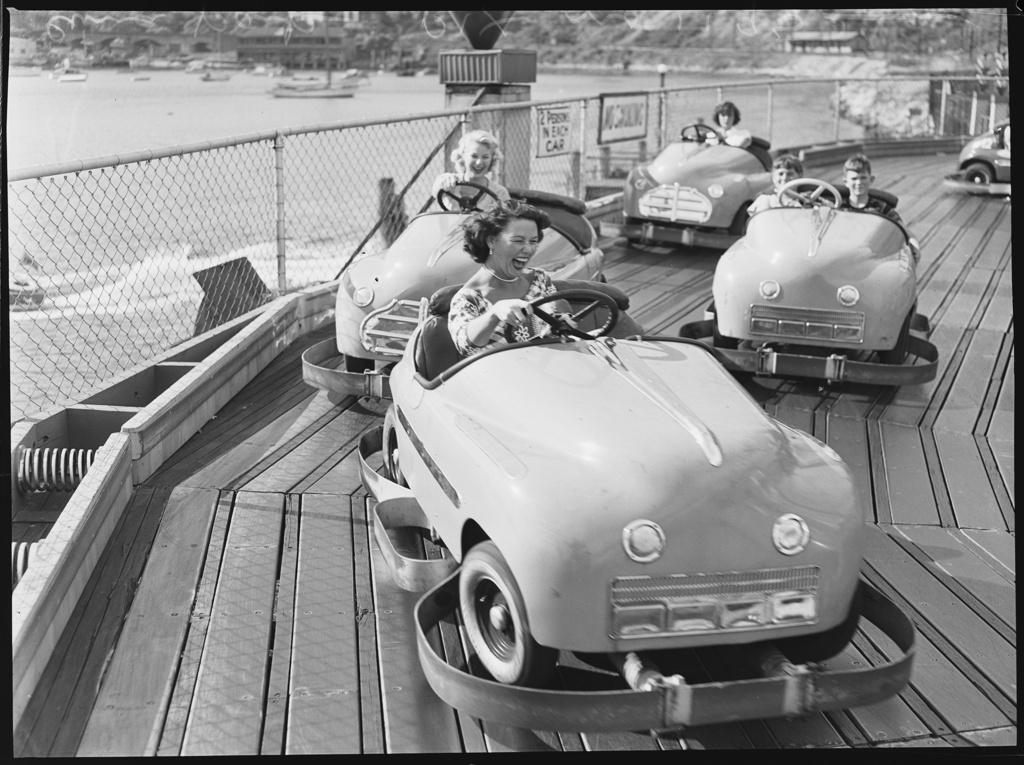
Image: Dodgem cars, Luna Park, November 1952 _ photographed by Ivan Ives, c/- State Library of NSW on Flickr. Drake, is a Canadian rapper musician, who is currently the most streamed artist of all-time on Spotify, with his songs having been played over 46 billion times, as of April 2022.) He also popularised the saying YOLO (abbr. you only live once). A tanka after Drake Equation by British-Nigerian poet Gboyega Odubanjo

You’ll have to find your own Drake (just ask anyone under 40). Meanwhile here’s US bassist and singer Esperanza Spalding with her 2008 album Esperanza, (Youtube) maybe start with Samba em Preludio (Youtube)

a tanka sonnet — August 2

as sun leaves the wall
spider gets busy 
sowing sails and vacancies
scaled to her prey 
in hopper legs and fly husks 

how like this, this is— 
line on line and beauty
bent round purpose 
like a bonsai cypress 
framed by chicken wire 

and how wrapt we are
beguiled by gravity 
stuck, barely able 
to remember the door

Image: A favourite wall in Wollongong, rear of the Bridgestone Tyres outlet, McCabe Park. A bit of play with forms today (apols to any tanka purists, the syllable count doesn’t work either).

And for music this morning, here’s another piece from favourite US soul guitarist Shuggie Otis, Live in Williamsburg (Brooklyn) from 2014 (Youtube).

Chasing the Line – An Anthology of Poems from the Back Room

Chasing the Line: An Anthology of Poems from The Back Room; Well Thumbed Poets 2022, 139pp. $25 (+ p & h) from Well Thumbed Poets

The back room of the title refers to a room in a bookseller – Well Thumbed Books in Cobargo NSW, a small town four hours south of Sydney on the Princes Highway between Narooma and Bega. 

The introduction to this volume describes a long wooden table where a group of seven local poets —  Linda Albertson, Leigh Crowe, Kai Jensen, Kate Taylor, Sandra Taylor, Glenda-mai Morgan and Peter Storey — have worked over the past few years to produce this rich volume. The latter two also provided the gorgeous colour illustrations for cover and the chapter dividers. 

Continue reading

similes

don’t you just love how along a line
                        there’s a word that signifies
                        a lit fuse spitting in a milk bottle

watch out reader          stand away

this poem is about to        l a  u   n    c      h
into some parallels            unexpected               revelatory              (or dull) 

fresh takes on the familiar: car-crash, swan, a vase falling floorward 

do it
I'm so ready 
to be arrested by 
outré ways 
of looking 
at water
-birds &c.

Image: c/- Rijksmuseum on wikimedia commons. One of a pair of porcelain swans are small versions of the famous large porcelain birds from the Meissen porcelain factory. From 1749 onwards, the successful Paris dealer Lazare Duvaux had several pairs of similar swans fashioned into candelabra. This pair may have come from his shop. A bit of silliness inspired partly by Marianne Moore’s poem ‘No Swan so Fine‘ and this amazing construction.

And for music this morning, here’s West African (Burkina Faso) singer song-writer Amadou Balake (1944 – 2014) with Taximen (dedicated to all those drivers out there making their way through the streets of Ouagadougou ) (Youtube)