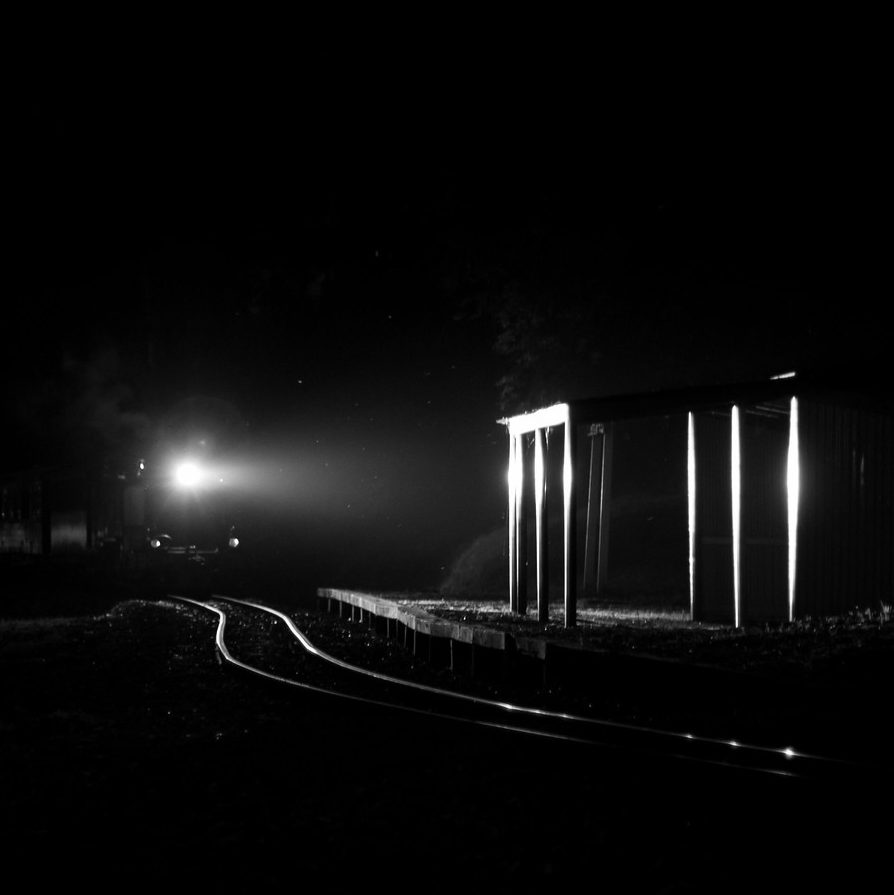
My friend shared a recurrent dream. She’d dreamt this off and on for nearly twenty years, long before she travelled on the northern express. She’s alone on a platform with two large suitcases as the train pulls up. The time to embark is short and she realises the suitcases are too heavy to get both onto the train in time. So she unpacks one, trying to make enough room for the essential stuff, the things she can’t bear to leave behind. But of course in the way dreams recur, the single suitcase is now too full and won’t shut—the straps snap, the latches misfire. Things, a favourite dress, poems she’s been working on, that photograph of her sister, spill out and are snatched away by the wind. And time is running out. The train doors slam, the brakes release and slowly at first but definitely now the train begins to move.

I mention this only because on the northern express, the same scene was repeated again and again by people with overfull shopping bags or saggy cardboard boxes. There was one family who nearly didn’t make it: the mother swaddled a newborn while shouldering her backpack; the father had a backpack, a front satchel, two shopping bags and a sleeping roll and herded two grizzly five-year-olds, each trailing their own luggage, towards the exit. The conductor had to hold the train.

Most people manage, except the old guy in the seat in front of me. He explained about a recent shoulder reconstruction as he fished for his pack on the parcel shelf with his walking stick. I offered to help but he muscled it down on his own and wincing slung it over his shoulder. A wan farewell and then he hobbled off down the aisle. I saw him pushing his walker slowly along the platform as we moved off. Later at the terminus I noticed that he’d left his leather hat behind. Life is a process of acquiring and then sloughing off stuff until we walk again bare headed in the world.

we move at ground level
at sea level
the tracks run out
onto the sand
sky arches over

At Gosford, Jasmine took the seat next to me. She was travelling to Wauchope, where her Mum would meet her. They’d spend the weekend together and she would fly back on Monday. She was well-prepared for the trip and after these brief pleasantries, slipped on her headphones to watch a reality show called ‘Love is Blind’ on her tablet. Occasionally I’d sneak a look at her screen. This episode involved fit young women and men lounging about poolside, drinking from silver goblets and flirting with each other while ignoring the camera crew and the sound guy leaning in to catch a whisper. Set ups and let downs were everywhere: partners came on to strangers, were unfaithful, and later couples confronted each other, argued and tearfully cancelled their engagement. The episode that Jasmine had downloaded came with subtitles and these formed a kind of haiku chorus to the action on screen: poolside [incomprehensible chatter]; back at the couple’s room [sobbing and sniffles]; alone in the corridor [emotional music rising].

Broadmeadow
sun dazzles between factories
corrugated blues and greens
walls of post-industrial rust

——

Each station more beautiful
summer palaces and fishing boats
billboards and quarries
intensified—
already the shadows deepen

We travel through time in armchairs. Daylight shifts from midday to a bright afternoon where colours are bleached, the shadows absolute. Then as the light slowly eases the buildings and ridgelines become more and more beautiful. Even ugly things—a blackberry bramble over a car wreck, a creek strangled with lantana, an abandoned warehouse half falling down—become splendid in this golden painterly light; the young mum pushing a pram along the platform at this hour looks like Botticelli’s Madonna.

And then, as if it fell off a cliff, the day is gone and with it the landscape. Now there’s just looming shadows and our reflections mirrored in the cabin windows. The train rushes on past a vacant station, traffic crossings, a farmhouse.

the empty platform
it’s late and the drunks
are rowdy in utes
I climb the hill with my suitcase
the hotel like a furnace
Image: Ribbons by Michael Greenhill on Flickr. A haibun-like piece on a recent train journey – with audio (just for fun – the music loop c/- setunian on freesound.org).
Here, you can book your own tickets on the Northern Express (travels between Sydney and Brisbane, though when I travelled the train only got as far as the border and coaches took passengers the rest of the way into Brisbane) For those of you interested, here’s more about Love is Blind.
And for music this morning, who else but Dylan with his own take on the northern express with Slow Train. (Youtube) from his 1979 album (Youtube) of the same name.





 Peter Frankis writes