a daily tanka — July 8

Roger Federer

is back       his backhand

as if he’d never

is quicker       quiet genius

moves       like a dream      thru the crowd

Image: Country week tennis, White City, Rushcutters Bay, Sydney. 1937. Photographer Sam Hood, c/- State Library of NSW on Flickr. This made perfect sense when I wrote this at 2am.

And for music this morning, here’s First Nations musician and composer Dr G. Yunupingu (commonly known as Gurummul) with the posthumous 2018 album Djarimirri – (Youtube) — The album was completed just weeks before his passing in July 2017 and presents traditional songs and harmonised chants from his traditional Yolngu life with orchestral arrangements. Stirring.

This poem was written on the land of the Wodi Wodi people who are the Aboriginal custodians of the Illawarra — and I pay my respects to Elders past and present.

a daily tanka — July 7

gulls bright in the storm
a squall rattles the coast
rain beats the glass beats
while we sip rosé, recall 
San Rémy, olives just like these 

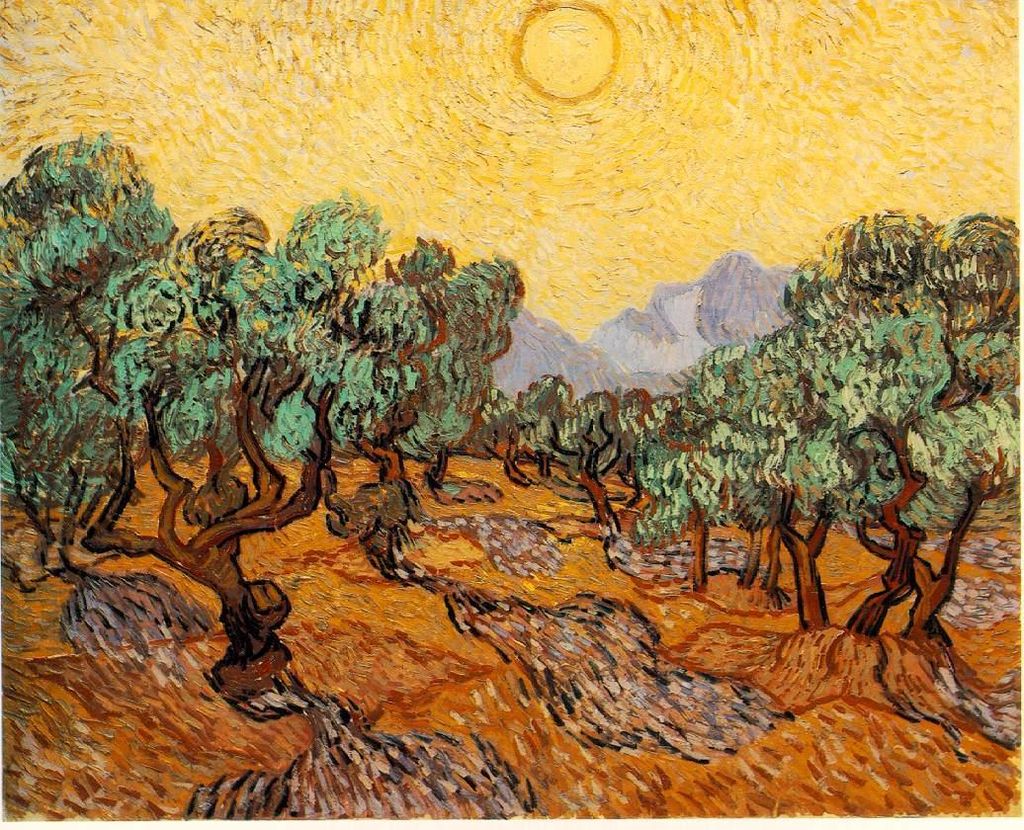
Image: Vincent van Gogh, Olive trees with yellow sky and sun, San Rémy, 1889 c/- Wikimedia Commons. How delicious, lunch at a restaurant with views across the crashing seas and the oncoming storm.

Music this morning? In keeping with yesterday’s journey back to the seventies, here’s an early collab between English ambient guru Brian Eno and German tech duo Cluster – called Cluster & Eno from 1977 (Youtube).

a daily tanka — July 6

how gently you
wipe that uh-oh of mayo
from my chin — 
now we can continue
                             uninterrupted

Image: My collage of domestic fruits. A tanka after David Terelinck, ‘how gently…’, Eucalypt 22, 2017

And for music this morning I was a little stuck for ideas, and then found myself in our local supermarket – and there was Sunday Morning from The Velvet Underground playing over the speakers. So here they are – Lou, John Cale, Morrison, Tucker and Nico from 1967, produced and cover art by Andy Warhol (Youtube).

the memorial, National Gallery, Canberra

Already on this winter’s weekday morning the National Gallery is crowded. Students hurry to tick off their learning assignments for their visit to the 4th Indigenous Triennial; a couple are carefully negotiating the concrete of the gallery’s halls one with a splayed gait and stick; an outdoorsy trio stare hard at their brochure, looking for landmarks, waypoints in their journey; restless security guards murmur into their lapels. 

The art competes for our attention: slogans in neon tubing, whooshing soundscapes, tvs of a muddy hand signing in Auslan while off-screen the artist shouts something. Other works are monumental in their silence. Here a three-metre-long dot painting is timeless, vast — a waterhole, another, a mountain range, there the spirit path. 

Label says: Uta Uta Tjangala, Pintupi people, 1920-1990 Australia, ‘Untitled’ 1987, Papunya, Northern Territory, polymer paint on canvas. Google adds: Tjangala was one of the founders of the Western Desert Art movement; that his home, Kintore, is a remote township 500 km west of Alice Springs; and in the 2016 census the town had a population of 410 people, of whom 93.7 percent identified as Aboriginal. 

the space between us
fills with facts
great databases
in splits of a second
as if my ignorance….   

A video loop on a wraparound screen shows the artist Gutiŋarra Yunupiŋu grinding ochre on a stone, and then masking his forehead and arms in yellow. He next appears standing in the oncoming waves. We’re low on the sand, lying in the water, the on-coming waves about to submerge us. I’m holding my breath.

once, far over the breakers
I caught a glimpse
of a white bird
and fell in love
with this dream which obsesses me.  
                          Yosano Akiko (1878-1942) *

Having seen enough, I become like those students, pulling back each curtain for a moment, a quick scan, what’s the deal here? — a dark room with display cases, boxes of cow bones, tick; another cryptic video installation, tick again.

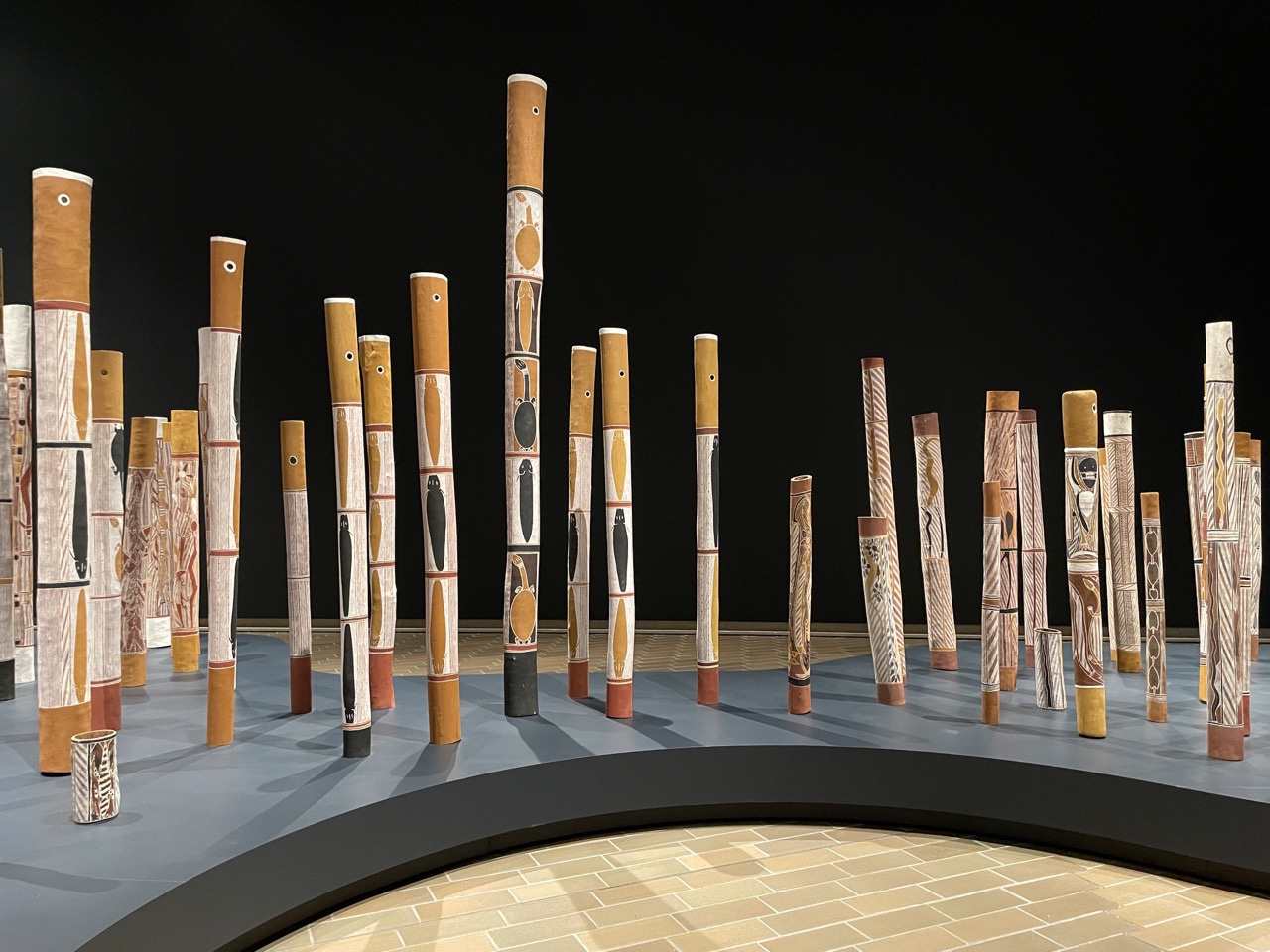
At last, the memorial room. Finally, I’m alone. It’s just me and the work. The memorial is 200 wooden poles. Some are waist high, others are over two metres tall. They’re tree trunks that have been hollowed out by termites, then cut and coloured in bands of white and ochre and red and black. Creatures turn around the poles: fish — lots  of fish, a long-necked tortoise, a climbing goanna, two jabiru , skeleton figures, a line of frogs. The creatures are drawn against a hatching of fine lines. Imagine the long thin brush that made these, the skilled movement, from paint bowl to wood again and again. 

Label says: 43 artists from northwest Arnhem land produced these poles. Also, these are funeral coffins.

The poles are arranged as a forest. There’s a path between them. Like a river they rise on each side, shift, clump together lean towards you, divide as you move through the memorial. 

there’s only task
and the doing: thoughtless 
the foot moves and again 
head forward, unbalanced
already in the future

Label says: the layout of the display follows the Glyde River as it makes its way to the Arafura Sea. The poles are arranged to approximate the artists’ home country — tortoise next to mangrove next to waterhole next to black snake. Boundaries overlap, intersections are everywhere. 

You could easily reach out and place your hand on a pole, trace the hollow, follow a goanna or water dragon (though I’m guessing that one of the guards might eventually look up from their phones and saunter over to ask you to stop). 

Label says: the work was commissioned for 1988, the bicentenary of the founding of the European colony in Australia. A pole for each year of dispossession, of frontier wars in a settler country that has yet to recognise through constitution or truth telling First Nations Australians’ rightful place in their own country. 32 years on from this first making, the colours are still vivid, the work as moving, and it still provokes questions.

artificial lake
Cook’s fountain blows snow
high into the grey
it’s hard being an optimist
in this austere chill.** 

Image: my photos of the memorial, National Gallery of Australia, Canberra. There’s much more about the memorial online.

* Akiko, Y. in K. Rexroth (trans.), One hundred more poems from the Japanese. New Directions. 1979, p. 14;

** Cook’s fountain or more correctly The Captain Cook Memorial and Jet sends water up to 150 metres into the air over Lake Burley Griffin, Canberra. It was installed in 1970 to mark the bicentennial of James Cook’s first sighting of the east coast of Australia.

And for music this morning, here’s a piece by American composer Philip Glass – called Mad Rush – (Youtube) though it was un-named when performed for the first visit by His Holiness the Dalai Lama to North America in 1979. Here’s the composer performing live at St John the Divine Cathedral in New York. Spine-tingling stuff.

This piece was written on the land of the Wodi Wodi people who are the Aboriginal custodians of the Illawarra — and I pay my respects to Elders past and present.

a flooded tanka — July 4

at the grocers
the girl checks her phone
as she scans my veg
feed of house, backyard frontage
their picnic table adrift

Image: People crossing a flooded street at Alexandria, Sydney. Photographer, Sam Hood, 1934 c/- State Library of NSW. As I write, another flood is inundating low-lying areas of Sydney and other parts of NSW.

And music this morning, here’s some pure Appalachian folk with Gillian Welch and her long-time collaborator Dave Rawlings with Boots Volume 1. The Official Revival Bootleg (Youtube)

a daily tanka — July 3

the storm howls about
bucketing trees, snatching hats 
trying doors and panes
— my collie stays close
that sky-dog quails her brave heart 

Image: Wollongong Radar, c/- Australian Bureau of Meteorology. Another east coast low swirls up in the Tasman Sea, so dog and I are on the couch.

For music this morning, here’s vocal trio Voice – with their album Hildegard Portraits (Youtube) – music marking the tenth anniversary of the canonisation of the 12th-century spiritual leader, theologian, mystic, scientist and composer, St. Hildegard of Bingen (1098-1179). (Wondering why it took so long for the church to get around to granting her sainthood? The answer is here)

5 variations tanka — July 2

I ask you
a dozen questions
                             — as expected —
it’s not your words
that hold my attention * 

I ask you
a dozen questions
then forget
            every answer
                           — just the sound of your voice...

I ask you
two dozen questions
tho I forget
a dozen answers
               — your laugh a complete snowfall 

I ask you
a dozen questions
tho I forget
a dozen answers
              a plate crashes to the tiles

I ask you
a dozen questions
tho I lose
all the answers
                 — the river in flood

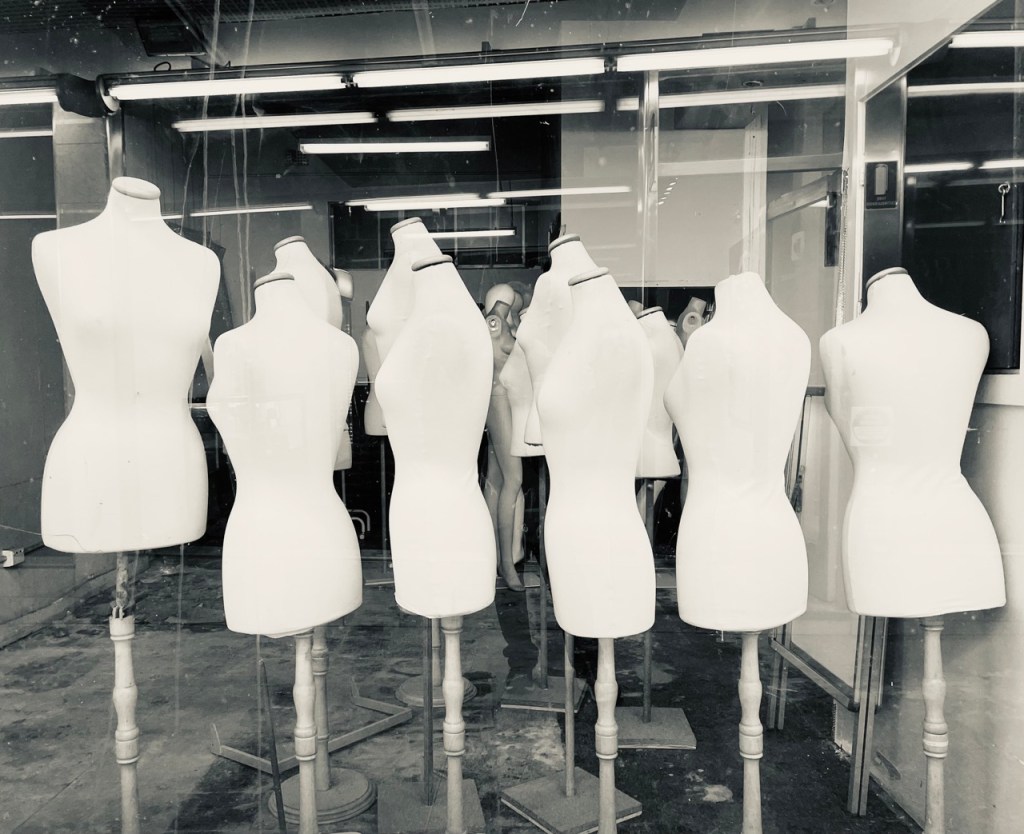
Image: My photo, vacant dressmaker’s shop, Globe Lane, Wollongong. * this line borrowed from Patricia Prime, Eucalypt, 2010, p. 21.

And for music this morning, something from Afrique. Here’s Malian singer and guitarist, Afel Bocoum with his 1999 album Alkibar (youtube), recorded in an abandoned school near Niafunke a small village on the banks of the Niger River. “Alkibar set finger-picked guitar melodies and soulful vocals, in the Sonrai, Fula, and Tamashek languages, to a musical tapestry of lute, monochord njurkle, calabash, spike fiddles, and a three-voiced choir.” 

a daily tanka — 1 July

yesterday’s 

exercise chalked  

on the pavement

keep going ... nearly done ...

good job ... smiley face

Image: Physical culture class at the Bjelke-Petersen School of Physical Culture, Sam Hood photographer, c. 1934 c/- State Library of NSW on Flickr. A very determined quartet of athletes. Nothing profound this morning.

And for music, here’s Tibetan singer composer Yungchen Lhamo with her new album Awakenings (Youtube). I know I get carried away with these musical offerings but this album is one you really should listen to twice then go out and buy. Wonderful music to write poetry to and proceeds support the charitable foundation One Drop of Kindness – assisting people in Tibet, Nepal and India, in the USA, and in Ireland.

a daily tanka — June 30

round here the parks have

harbour buoys and anchor chains

strewn over the grass 

tho plaques explain

unmoored, our past sails on 

Image: Port Kembla Maritime Park, I’ve been wanting to stop at this little neglected park for ages but it’s trapped between busy roads and across from the busy courthouse.

And for music, here’s Canadian world music ensemble Constantinople with kora maestro Ablaye Cissoko with their album Itinerant Gardens (YouTubers)

found tanka — June 29

as he eats

he eyes 

the world

in his spoon

— how might

it end

for this man

this white carton

this suffering ?

An erasure (with a few liberties) of Jane Kenyon’s poem Man Eating, from Let Evening Come, Selected Poems, Bloodaxe Books, 2005, p. 128. (A marvellous collection from a fine poet gone too soon – if you’ve not read her poem ‘Having it out with melancholy‘ take a moment, it’s right here).

And for music this morning, some Indo-Baroque meets alt-folk minimalism from British string duo Balladeste — a collaboration between violinist Preetha Narayanan and cellist Tara Franks. Here’s their 2021 album Beyond Breath (Youtube).